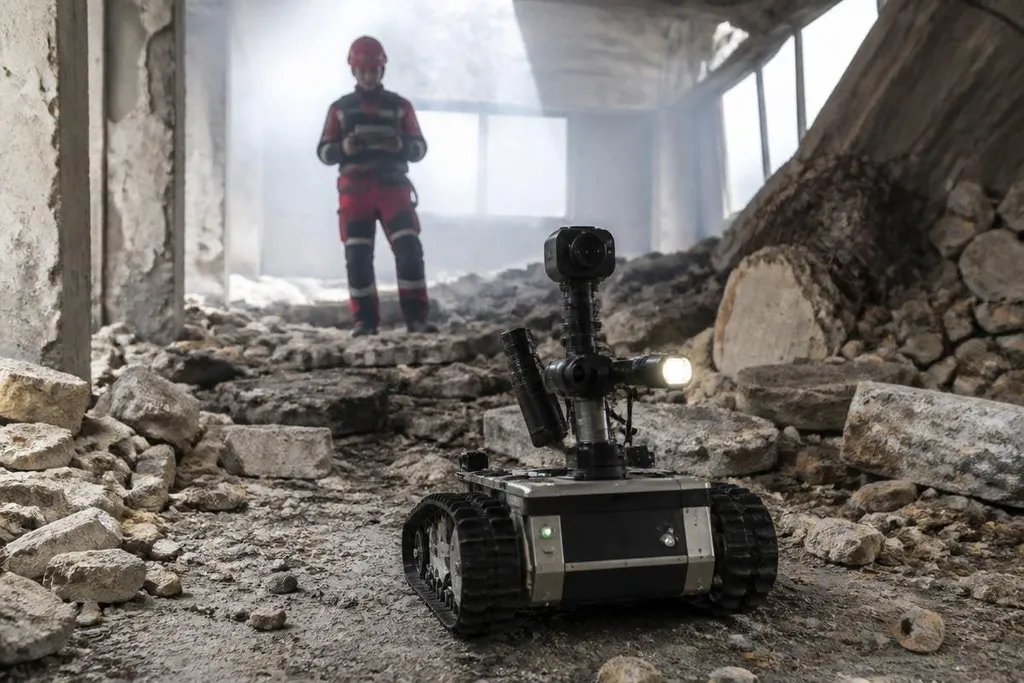
A disaster robot may face smoke, broken floors, poor lighting, lost signals, and people who need help. A machine that works in a clean test area can fail quickly when its map, sensors, or radio link become unreliable.
The real test is simple to state: can the robot help people in a damaged place while keeping its operators safe? That question matters more than a polished demonstration.
- Bad maps change the job: rubble can block routes and hide hazards.
- Remote control has limits: walls, dust, and distance can cut the radio link.
- Useful work beats movement: finding a person or opening a path matters more than walking far.
The ground changes under the robot
Disaster sites are hard places for robots to move. Loose material may cover floors, broken stairs can block progress, and narrow gaps may force a robot to turn or reverse.
Designs differ. A tracked robot can cross loose ground and carry a larger battery, but steep steps may stop it. Legs place feet around obstacles. That takes more control and power, so the right design depends on the task, site, and setup time.
Sensors add another problem. Cameras can lose detail in smoke or darkness. LiDAR measures distance with light pulses, yet dust and reflective surfaces can make its map harder to trust. Operators need a way to see sensor confidence, not only a neat picture of the scene.
That is why disaster testing should include poor visibility, blocked routes, and changing surfaces. A robot that reaches a target once has shown a movement demo. It has not shown that it can repeat the task during a long response.
Communication can decide the outcome
Many disaster robots depend on teleoperation, where a person sends commands from a safer position. The control link must carry video, robot status, and movement commands with little delay. A blocked signal can turn a careful task into a stationary machine.
Teams can reduce that risk with relay nodes, wired links, local control, or a mix of these methods. Each option adds equipment, setup time, or limits on where the robot can go. A smaller robot may be easier to move into a building, while a larger system may carry stronger radios and more power.
Those control choices need a field record. Robot24.com disaster robotics coverage can connect a robot’s task to the site, date, operator input, and measured result. That record matters when the next test asks whether the robot can do useful work after reaching the danger zone.
Finding a survivor is only part of a response. A robot may need to move a light object, turn a valve, open a door, carry a sensor, or place a camera where a person cannot safely stand.
Those tasks need force control. The robot must push hard enough to move an object without crushing it or losing balance. A gripper that works on a rigid test handle may fail on a damaged door with an uneven surface.
Human control can help with rare or delicate actions, while onboard software handles steady movement and sensor checks. That division reduces the operator’s workload, but it also creates a limit: the system must show when it needs a person to take over.
What a serious test should measure
The global race will be easier to judge when teams publish the same practical details. A useful trial should record:
- Time to deploy: how long the team takes to unpack, connect, and start the robot.
- Control range: where the operator can work before the link becomes unusable.
- Task completion: which actions the robot finishes without a reset or manual repair.
- Battery change: how long the robot runs and how its power pack gets replaced.
- Recovery after failure: whether the robot can stop safely, report the fault, and resume.
These measures expose the gap between a machine built for a demonstration and one prepared for field work.
They also help emergency teams compare a small tracked vehicle with a legged robot or a flying system without treating movement as the only result.
A buying checklist for response teams
Before choosing a disaster robot, ask:
- Can the team carry it through a doorway and set it up without special lifting gear?
- Does it keep a safe state when the radio link drops?
- Can operators read battery level, temperature, signal quality, and sensor faults?
- Which tasks can it perform with a camera, arm, or other tool attached?
- Has the maker shown repeat tests on damaged ground rather than one clean run?
I'd judge a disaster robot by the work it completes after the first fault, not by how smoothly it moves in a prepared room. Until teams publish repeatable field results, the race remains a contest of prototypes rather than proof of dependable rescue work.